
When someone asks an AI platform for a lawyer in South East Queensland, which firms does it name, and what do those firms have in common? Felicity Jane Digital asked ChatGPT, Perplexity, Claude and Google’s AI Overviews the same nine questions, ten times on each platform, in August and September 2026, and recorded the law firms each response presented as a firm to contact, under the rules in the full report. As a legal marketing agency that sells services in several of the areas this study measures, including structured data, Google Business Profile and website content, Felicity Jane Digital registered the study’s method in advance on the Open Science Framework and has published its full method and limitations. Results are reported for groups of firms. Apart from ten firms listed by website domain in the registration as examples of organic search results, no firm is identified.
What the study found. The firms AI platforms named consistently for a question were more likely to show four signals than a random sample of 45 firms that no platform named for the same question (5 for each question): a listing in the Queensland Law Society’s Find a Solicitor directory, structured data on their website, a more complete Google Business Profile, and a post on their own website within the previous 90 days. The directory difference was the largest, and it ran in the same direction in all nine combinations of practice area and location. Google review count, compared for commercial litigation only, did not follow this pattern. About two in five firms a platform named for a question appeared in one run only (335 of 810 entries). Agreement between platforms was low: of the 74 firm and question pairs named consistently, just over half (38) were named consistently by one platform only. These are associations in a small exploratory study, from AI runs recorded in August and September 2026 and websites and listings examined between 28 September and 5 October 2026. They do not show that any signal causes a firm to be named.
Figure 1 · Four signals

A firm named in one run of a question was often absent from the other nine
A firm counts as named consistently when a platform named it in 7 or more of that platform’s 10 runs of the same question (7 of 9 for one question’s AI Overviews), a threshold set prior to data collection. Counting each firm once for each platform and question gave 810 entries. 137 of the 810 reached the threshold, and 335 (41%) appeared in a single run of ten. Perplexity named the most firms and had the highest share named once. For commercial litigation on the Gold Coast, Perplexity named 42 different firms across ten runs, each in fewer than seven of them.
A smaller group was named repeatedly. 137 combinations of a firm, a platform and a question reached 7 or more runs of 10, and 22 reached all 10. Some firms reached the threshold on more than one platform for the same question, and the 137 reduce to 74 firm and question pairs named consistently, covering 63 firms.
What it means for a law firm: each AI answer varies, and a firm named in one run may be absent from the other nine. A firm’s standing on a platform shows only across many runs of the same question.
Just over half of the firm and question pairs named consistently came from one AI platform only
The 74 firm and question pairs named consistently cover 63 firms. Just over half (38) were named consistently by one platform only. Seven were named consistently by all four.
Figure 2 · Agreement between platforms
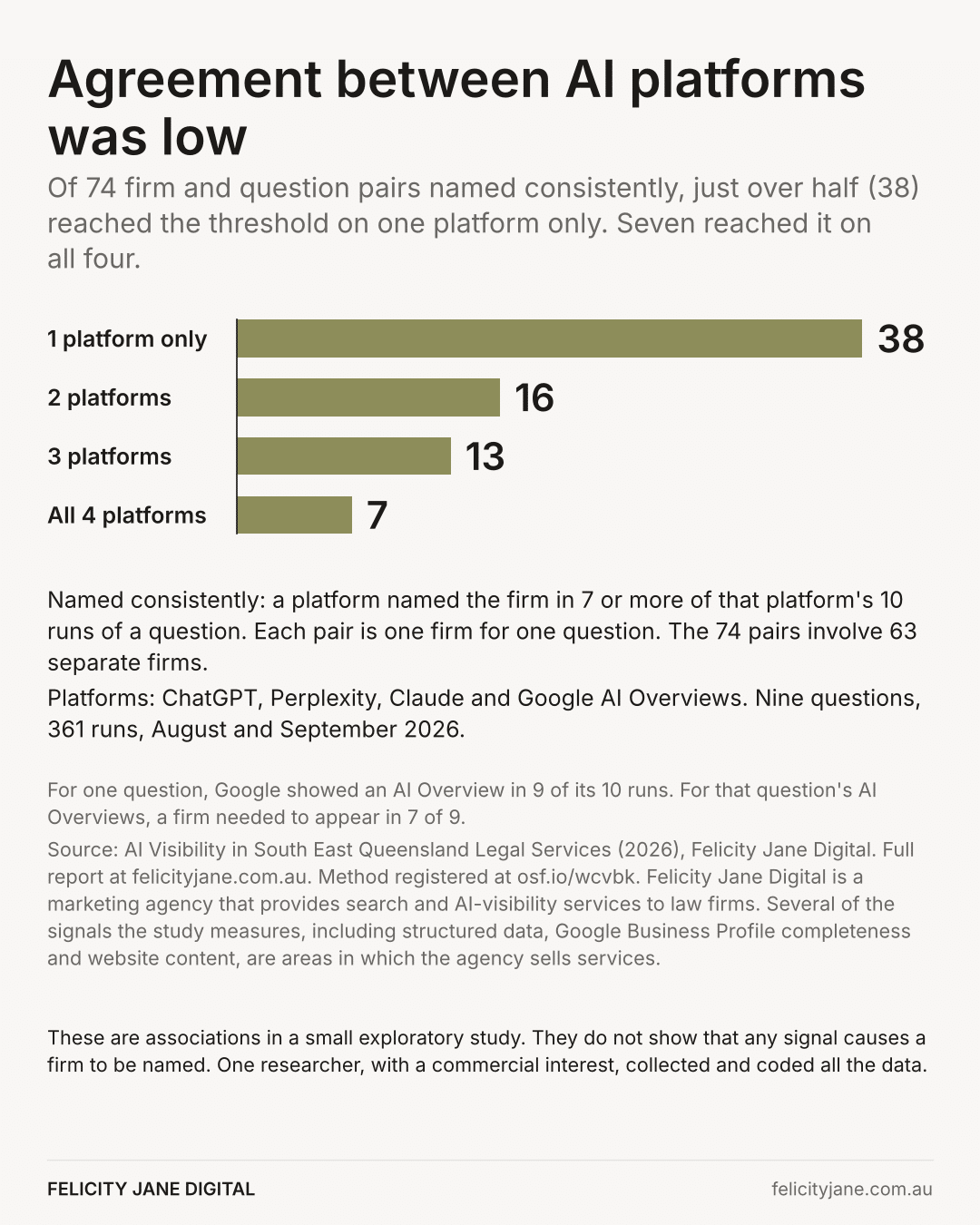
What it means for a law firm: the platforms overlap in part, and a firm named consistently by ChatGPT may have a different standing in Perplexity’s or Claude’s answers to the same question.
Firms named consistently were more often listed in the Queensland Law Society’s Find a Solicitor directory than a random sample of firms the AI platforms did not name
Of the 74 pairs named consistently, three in four were for firms listed in the Queensland Law Society’s Find a Solicitor directory (56 of 74, 76%). Of the 45 firms in the random sample, two in five were listed (18 of 45, 40%). The difference ran in the same direction in all nine combinations of practice area and location. The directory was searched at firm level, which may under-count listings.
LawConnect listings showed little difference between the two groups (50% of pairs named consistently and 44% of the random sample).
What it means for a law firm: a Find a Solicitor listing was more common among the firms AI platforms named consistently than among the random sample. The study records the association, and its cause remains open.
Firms named consistently more often had structured data on their websites and a more complete Google Business Profile
Structured data is code on a website that describes the business and its people to search engines. The study counted three types: FAQPage, LocalBusiness or LegalService, and Person. Other types were not counted. At least one of these types was detected for 62% of the pairs named consistently (46 of 74), against 31% of the random sample (14 of 45). The share was higher among the pairs named consistently in each of the three practice areas. Three pages of each website were tested, and sites that could not be tested count as not detected.
A Google Business Profile scoring 4 or 5 out of 5 for completeness was held for 43% of the pairs named consistently (32 of 74), against 24% of the random sample (11 of 45). The score counts five elements: a business description, a primary category, a services section, the firm’s own photos, and a post within 90 days. Of the elements the report publishes, the widest gap was in the firm’s own photos (81% against 58%).
The same researcher re-scored a random 13 of the 123 records without seeing the first scores, 14 days after the last observation. Both signals met the study’s reliability standard. This is a consistency check by one person, with disclosed help from an AI assistant, and the full report sets out its limits. Websites and listings were examined after the AI platforms had been asked the questions.
What it means for a law firm: structured data and a complete Google Business Profile were more common among the firms AI platforms named consistently than among the random sample. Established firms may score well on many of these signals at once, and the cause remains open.
Firms named consistently had more often published on their websites in the previous 90 days
Of the firms named consistently that had an article or news post showing its publication date, 74% had published one in the 90 days prior to examination (37 of 50 firms). Of the sample firms with a dated post, 48% had (15 of 31). Websites were examined between 28 September and 5 October 2026, after the AI platforms had been asked the questions. A recent post may therefore postdate a firm’s appearance in AI answers.
What it means for a law firm: recent publishing was more common among the firms AI platforms named consistently than among the random sample. Firms that publish often may differ from other firms in several ways at once. Recent publishing is an association, and its cause remains open.
About half of the pairs named consistently were for firms that also ranked in Google’s top 10
Of the 74 pairs named consistently, about half were for firms that also appeared in Google’s top 10 organic (unpaid) results for the same question (39 of 74, 53%). For pairs named consistently by Google’s AI Overviews, four in five did (24 of 30, 80%). AI Overviews form part of Google Search, and part of that overlap is built in. For pairs named consistently only by ChatGPT, Perplexity or Claude, one in three did (15 of 44, 34%).
The matching figure for the random sample is not reported, under disclosure rules set after the figure had been calculated, as the full report explains. Without it, the study leaves open whether a top 10 ranking is linked to being named.
What it means for a law firm: a top 10 Google ranking was common among the firms named consistently by Google’s AI Overviews, and less common among those named consistently by ChatGPT, Perplexity or Claude only.
The findings describe four AI platforms’ answers in August and September 2026
The study records what four AI platforms named in response to nine fixed questions, asked from one Sunshine Coast internet connection, and what the firms’ websites and listings showed shortly afterwards. AI answers change over time and vary between users, and the findings describe that period. The results record the platforms’ selections and make no assessment of any firm’s legal work.
How the study was conducted
Figure 3 · How the study worked
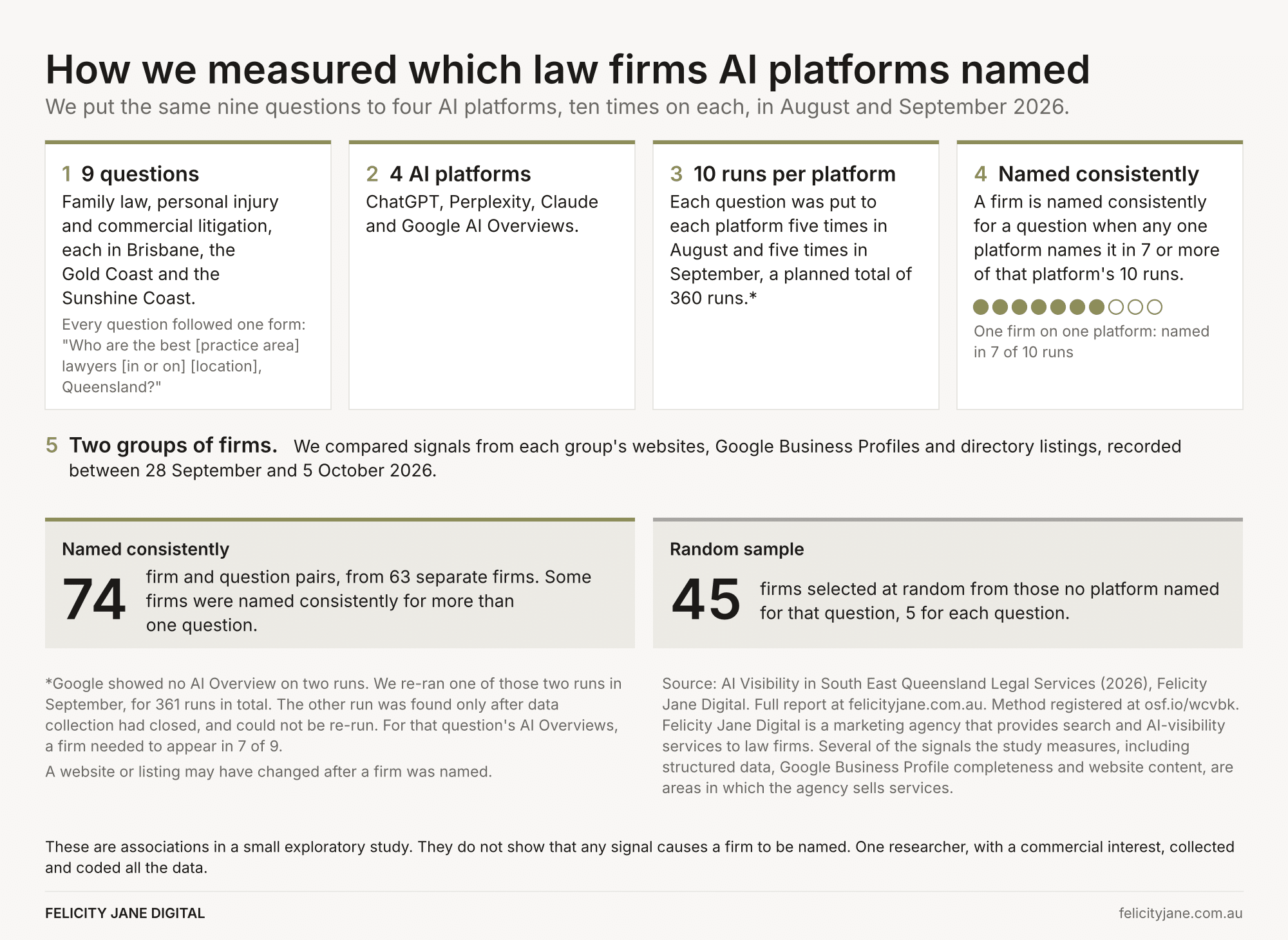
- Questions: nine, covering family law, personal injury and commercial litigation in Brisbane, on the Gold Coast and on the Sunshine Coast, each in the form “Who are the best [practice area] lawyers in Brisbane, Queensland?”, with “on the Gold Coast” or “on the Sunshine Coast” for the other two locations.
- Platforms: ChatGPT, Perplexity, Claude and Google’s AI Overviews.
- Runs: each question was put to each platform ten times, in two waves, from 10 to 18 August and from 14 to 22 September 2026: 361 recorded runs across the four platforms, including one replacement run. For one question, Google showed an AI Overview in 9 of its 10 runs; the full report gives the details.
- Comparison: 45 firms, selected at random from listings no platform named for that question, 5 for each question, drawn from 805 Google Business Profile listings for the three practice areas and locations.
- Registration: the method was registered on the Open Science Framework on 3 August 2026, prior to any data collection (osf.io/wcvbk).
The full report sets out each step of the method, the 54 amendments recorded after registration, and the study’s limitations. Read the full report.
Questions law firm principals ask about AI recommendations
Does the study show what causes a firm to be named? No. The study observed which signals the firms named consistently had in common. It did not test whether any signal causes a platform to name a firm. The full report sets out propositions a later study could test, and eight directions for further research, such as measuring how often a firm is named before and after a change to one signal.
Does a strong Google ranking mean AI platforms will name a firm? The study cannot say. About half of the pairs named consistently were for firms ranked in Google’s top 10. The matching figure for the random sample is not reported, under disclosure rules set after the figure had been calculated.
Do all AI platforms name the same firms? In part. Of the 74 firm and question pairs named consistently, 38 were named consistently by one platform only and seven by all four.
Do Google reviews affect which firms are named? The study cannot say. Reviews were compared for commercial litigation only. The firms named consistently had a lower median review count than the 15 sample firms in commercial litigation (34.5 against 60), and the two groups’ ranges overlapped almost entirely.
Which signals did the study examine?
- Google ranking for the same question
- Structured data on the firm’s website
- Google Business Profile completeness
- How recently the firm published on its website
- Google review count, for commercial litigation only
- Listings in the Queensland Law Society’s Find a Solicitor directory and in LawConnect
About the figures
Each share in the table below has an approximate 95% interval, showing where that group’s share probably lies. Each interval describes one group. Comparing intervals is not a test of the difference between groups.
| Figure | Share | 95% interval |
|---|---|---|
| Listed in Find a Solicitor, pairs named consistently | 56 of 74 (76%) | 65% to 84% |
| Listed in Find a Solicitor, random sample | 18 of 45 (40%) | 27% to 55% |
| Listed in LawConnect, pairs named consistently | 37 of 74 (50%) | 39% to 61% |
| Listed in LawConnect, random sample | 20 of 45 (44%) | 31% to 59% |
| Structured data detected, pairs named consistently | 46 of 74 (62%) | 51% to 72% |
| Structured data detected, random sample | 14 of 45 (31%) | 20% to 46% |
| Google Business Profile scoring 4 or 5, pairs named consistently | 32 of 74 (43%) | 33% to 55% |
| Google Business Profile scoring 4 or 5, random sample | 11 of 45 (24%) | 14% to 39% |
| Published within 90 days, firms named consistently that show post dates | 37 of 50 (74%) | 60% to 84% |
| Published within 90 days, random sample firms that show post dates | 15 of 31 (48%) | 32% to 65% |
| In Google’s top 10, pairs named consistently | 39 of 74 (53%) | 41% to 64% |
| In Google’s top 10, pairs named consistently by AI Overviews | 24 of 30 (80%) | 63% to 90% |
| In Google’s top 10, pairs named consistently only by ChatGPT, Perplexity or Claude | 15 of 44 (34%) | 22% to 49% |
About this research
Research disclaimer
This research is descriptive, not evaluative. It does not constitute a quality assessment of any Queensland law firm. A firm’s presence, absence or frequency in the AI-generated outputs sampled should not be read as an indication of legal competence, service quality, client satisfaction or professional standing.
Who conducted this research
This research was conducted and is published by Felicity Jane Digital, a marketing agency that provides AI-visibility and search optimisation services to businesses, including law firms of the type examined in this study. Felicity Jane Digital is not an independent third party in relation to the market this research examines, and readers should take this relationship into account when considering the findings.
Methodology and scope
Findings are based on a sample of outputs generated by ChatGPT (OpenAI), Perplexity AI, Google AI Overviews and Claude (Anthropic) in response to defined queries relating to legal services across the Brisbane, Gold Coast and Sunshine Coast regions of Queensland. Queries were run between 10 August 2026 and 22 September 2026. Google results are the AI Overview as first displayed, and Perplexity was queried through a signed-in study account. Results were compared against a population of 805 Google Business Profile listings for law firms in the defined practice areas and locations. A firm with more than one qualifying office or practice area may appear more than once in that count. Firms without a disclosed street address were excluded, so the population is not a census of Queensland law firms. The registered methodology, sampling parameters and prompt design are available at osf.io/wcvbk, with post-registration notes in the associated project at osf.io/c63dk.
How firms are reported
Apart from ten firms listed by website domain in the registration as examples of organic search results, no firm is identified. This publication does not name those ten firms. Figures that describe firms’ characteristics rest on at least 10 distinct firms, and comparisons are pooled by practice area. For those figures, where 90% or more, or 10% or fewer, of a group share one value, the figure is combined with others or not reported. Counts that would point to a single firm are not published, with two exceptions: one difference of one, disclosed beside the figures it concerns, and the counts for the adviser’s firm in the conflict-of-interest paragraph below.
A snapshot, not a current or ongoing status
AI-generated outputs are not static or deterministic. The same or similar queries may produce different results on a different date, with different wording, or on a different platform. The findings in this publication reflect a snapshot as at the sampling dates stated above and do not represent an ongoing, current or guaranteed position for any firm or category. Website and Google Business Profile signals were observed between 28 September and 5 October 2026.
Use of AI tools in this research
An AI assistant, Claude (Anthropic), was used to help transcribe the saved screen captures into the study’s data logs. The researcher checked and entered every transcribed entry. Corrections to 57 Google AI Overview records, made on 13 October 2026, were entered by the assistant from the researcher’s recorded decisions, and the researcher checked a random 6 of them. Corrections to the website, listing and directory records, made from 19 to 21 October 2026, were also entered by the assistant, each with the researcher’s approval. One further set of changes to those records, made on 19 October 2026, has no record of who made it or of any approval; the researcher reviewed and decided each change on 21 October 2026. The assistant also drew the re-check samples, ran comparisons, calculated figures and helped draft study documents, under the researcher’s direction. Where Claude (Anthropic) is one of the platforms studied, its responses were collected through a separate study account.
Two re-checks were made by the researcher, coding a second time from the saved records, without seeing the original coding and at least two weeks after it. They are consistency checks by the same person, not independent reviews.
- Firm mentions: 37 of 361 runs, drawn at random, re-coded on 8 October 2026. Positive specific agreement 0.876 (95% interval 0.805 to 0.937), against a reference point of 0.800. That reference point was designed for a measure that corrects for chance, so it is used here as an approximation.
- Website structured data and Google Business Profile completeness: 13 of 123 firm records (one record per firm per practice area and location), drawn at random, re-scored on 19 October 2026. Structured data: 13 of 13 records agreed (95% interval 0.772 to 1.000; alpha 1.000). Google Business Profile completeness: 62 of 65 element judgements agreed (95% interval 0.862 to 1.000; alpha 0.905). Reference point 0.800.
The samples are small, so these figures are approximate.
In both re-checks the researcher did all the coding and gave every value. At her request, the AI assistant explained the process for the first records and, before each sheet was locked, checked it for empty cells. When the researcher raised a coding question, it pointed her to the written rule or rules that applied, without saying how they applied. In the second re-check that is disclosed as arguably advice on a scoring judgement. In the second re-check it also read out two records’ dates, and after the lock it read three evidence files to confirm the researcher’s reading of the disagreements, all in one record. These depart from the method set for the re-checks and are disclosed in the post-registration notes.
Reviewer conflict of interest
A legal adviser was engaged to review the study’s methodology and publication materials: defamation and identifiability risk, data retention, the adequacy of the study’s disclaimer under the Australian Consumer Law, and claims about AI. The adviser’s own firm appeared in the AI-generated results for one of the study’s nine queries, in 4 of 10 runs on each of two platforms. That is below the threshold of 7 of 10 runs used to define consistent appearance. The firm was captured under the same protocol as every other firm, and the adviser took no part in collecting, coding or analysing the data. The adviser declined to advise on the wording of this disclosure, citing Rule 12 of the Australian Solicitors’ Conduct Rules, and no lawyer has reviewed it. Neither the adviser nor the firm is named.
No endorsement or affiliation
This research is not affiliated with, endorsed by, sponsored by, or reviewed by OpenAI, Perplexity AI, Google or Anthropic.
Verification
The registered methodology is publicly available for independent review at osf.io/wcvbk. The post-registration notes, with firms replaced by study codes, are available at osf.io/c63dk. Apart from the registration, records that name firms are kept privately. For each named record with a published coded version, a SHA-256 fingerprint of the named original is published beside it, so the private record can be matched to it without identifying any firm.
Scope of this disclaimer
Nothing in this disclaimer is intended to exclude or limit any liability Felicity Jane Digital may have under the Australian Consumer Law or otherwise for the contents of this publication. This disclaimer is intended only to clarify and qualify the nature, scope and limitations of the findings presented in this document.
Jane is always happy to talk through any part of this study. For a firm that wants to know where it stands, the SEO audit for law firms includes a check of whether the firm appears in AI-generated answers, and where the structural gaps sit.
